Wind Energy

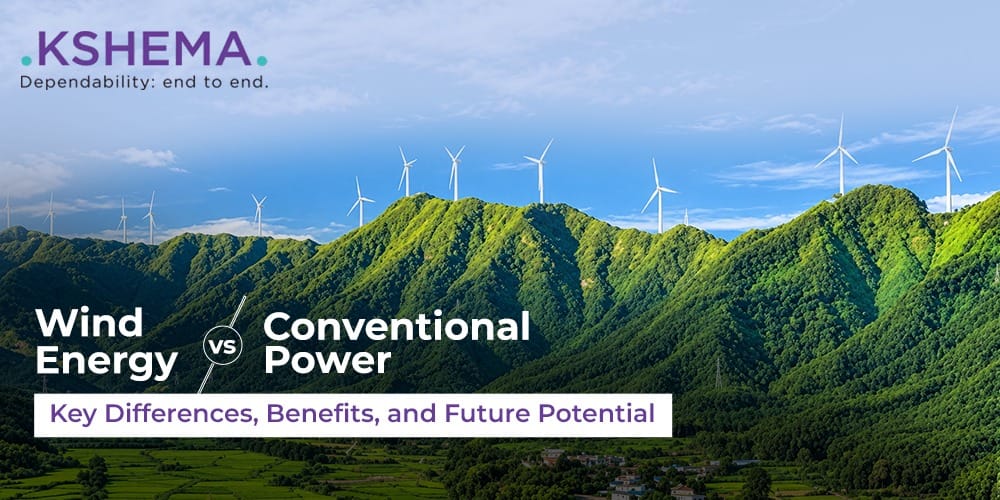
Wind Energy vs Conventional Power: Key Differences, Benefits, and Future Potential

India has installed 6.05 GW of new wind capacity in FY2025–26, which is the highest the country has recorded in a single year, ahead of the 5.5 GW added in FY2016–17. By the end of September 2026, the total had reached 59.2 GW according to MNRE, and Gujarat alone had about 17 GW of it.

In conventional power sources, gas, oil, and coal have always been leading for over a century in generating power. But keeping in mind the economic and environmental landscape, the transition is bigger. In wind energy, technological advancements have brought efficiency, sustainability, and long-term competitiveness. In this comprehensive guide, we will talk about the technical, economic, and environmental differences between wind and conventional power, explaining why renewables are becoming the pioneer of modern energy transformation. 

What is wind energy and how does it work?

Wind energy is produced by turning the movement of air into electricity. Turbines with long blades catch the force of the wind, and that force makes the blades spin around a central rotor. The spinning rotor drives a generator housed in the nacelle, which changes the mechanical energy into electrical energy. The electricity then travels through cables to a substation and into the grid, where it supplies homes, factories and offices.

Wind turbines are built in two main types, onshore and offshore. Onshore wind farms stand on land and are the more common choice because they are quicker to install and are low maintenance. Offshore wind farms are built in the sea, where the wind is stronger and more consistent, so each turbine can produce more energy.

Wind vs conventional power: the key differences

The table below puts the two side by side.

AspectConventional power (coal, gas, oil)Wind energy
How power is madeCoal, gas or oil is burnt to make heat. The heat turns water into steam, the steam spins a turbine and the turbine runs a generator. A gas plant can skip the steam step and burn the fuel straight in a turbine, though many add a steam stage afterwards for extra output.Wind pushes against the blades and the rotor turns. That rotation drives a generator, either through a gearbox or directly. There is no fire and no boiler.
EfficiencyA typical coal unit turns around a third of the fuel’s heat into electricity. The rest escapes as waste heat through the chimney and the cooling system.A modern turbine can capture 45 to 50 per cent of the energy in the wind passing through its blades. The theoretical limit is 59.3 per cent, called the Betz limit. Since the wind is naturally produced, the energy a turbine misses does not cost anything.
Fuel and supplyCoal is mined, loaded onto rail wagons and stored at the plant. India also imports crude oil, LNG and some coal, so part of the power cost follows global prices.Procurement and supply-chain requirements are minimal, with limited movement of major components such as wind turbine blades and other construction materials. 
EmissionsIPCC median estimates over the full life cycle are about 820 g of CO₂-equivalent per kWh for coal and 490 g for gas. These plants also release sulphur dioxide, nitrogen oxides and fine ash.About 11 g of CO₂-equivalent per kWh for onshore wind, counting manufacturing, construction and decommissioning. A running turbine releases no emissions at all.
WaterBoilers and cooling systems use a lot of water every day. This becomes a problem in dry districts.There is less wastage of water. Some water goes into cleaning and maintenance, and that is about all.
Cost patternThe biggest running cost is fuel, so the price per unit moves up and down with coal and gas markets.Most of the money is spent before the first unit is generated. After that, the costs are maintenance, land lease and insurance.
OutputPlants can generate when the grid needs them to. Even so, average coal plant utilisation in India was only about 69 per cent in FY2024–25, according to Ember.Output follows the wind. In southern and western India, the winds are strongest between May and September, so the grid has to plan around forecasts, storage and other sources.
Land and siteA coal plant needs the plant site, ash ponds, rail links and usually a mine somewhere.Each turbine takes up a small pad. Farming and grazing continue around it. The heavy civil work goes into foundations, access roads and the line that carries power to the substation.

Advantages of wind energy

Here are the benefits of renewable energy that must be considered: 

  • Provides a renewable and sustainable power source

Wind energy depends on natural air movement, which is frequently refilled by the sun’s heating of the Earth. Unlike fossil fuels, wind can never run out or be depleted. This makes wind an inexhaustible resource, providing a reliable, long-term energy supply. The renewable nature of wind energy enables us to minimise dependency on finite energy sources, offering support to resilient power systems.

  • Cleaner air and a smaller carbon footprint

A coal unit puts carbon dioxide, sulphur dioxide, nitrogen oxides and fine ash into the air for every hour it runs. A turbine puts out none of these. Even after counting steel, concrete and blade manufacturing, the IPCC median for onshore wind is around 11 g per kWh, roughly one per cent of coal’s figure. Cleaner air also means fewer breathing and heart problems linked to thermal plant pollution, and turbines use very little water, which helps in dry regions.

  • Generate cost-effective energy

This is one of the important benefits of renewable energy. While upfront construction costs can be substantial, maintenance and operational costs are still low since wind power is free. This cost-effective solution makes wind energy a better and smarter investment, providing stable and predictable costs. 

Let’s understand this with an example: Wind tariffs in India fell to about Rs 2.43 per kWh by 2017–18, according to Ember’s 2024 analysis, and then rose again to around Rs 3.75 as land and equipment got costlier. Carbon Tracker studied coal plants worldwide in 2018 and found that up to 62 per cent of India’s existing coal capacity cost more to run than a new wind or solar plant would cost to build.

  • Less exposure to imported fuel

India imports most of its crude oil, a fair amount of gas, and some coal plants also depend on imported coal. Wind generated in Tamil Nadu or Gujarat stays inside the Indian grid. Every unit it supplies is one less unit that depends on a shipping route or an exchange rate. This is one of the best ways for sustainable energy.

  • Develops jobs and infrastructure

IRENA counted about 1.5 million wind jobs worldwide in 2023. A lot of that work happens near the site itself: tower fabrication, foundation construction, road building, cable laying, and long-term maintenance. A single wind farm keeps local contractors and technicians busy for years, which matters most in districts where farm income is seasonal.

  • There is Scalability and Flexibility 

A few turbines can supply a factory or a village. A large wind farm can feed a city. Planners can pick the size that suits the site, the nearest substation and the local land rules, instead of building a fixed-size plant.

What is the Future of Wind Energy?

India’s National Electricity Plan has a target of 124 GW of wind by 2032. Ember has worked out that this needs about 8.8 GW of new capacity every year between 2026 and 2030. 

The government is targeting 7.5 to 8 GW for FY2026–27. Land, transmission lines and the time taken to commission projects will decide whether that happens.

Coal’s role is changing as well. Ember expects average coal plant utilisation to fall from 69% to about 55% by FY2031–32, because cheap solar is filling the grid during the day. Wind can cover the hours after sunset in many places.

Hybrid projects put wind and solar on one grid connection and share the same evacuation line. A turbine delivers what it was designed to only when the foundation, the road, and the substation are finished on time. A delay in any one of them means lost generation.


Read More : A Practical Guide to Wind Energy BOP: Construction, Infrastructure, and Sustainability

Building a wind project? Get the groundwork right

Kshema Power India is a Chennai-based EPC company. It reports more than 4,500 MW of wind EPC work and a team of over 200 engineers and technicians. Its projects include wind parks and substations in high-altitude terrain in India and in desert conditions in the Middle East.

If your wind energy site is approved but the foundation or evacuation work has not started, or a project has stalled midway, talk to Kshema. Send your location and capacity to enquiry@kshemapower.com, and the team will tell you what it takes to get your turbines running.
Share On :
Scroll to Top

Narayan Kailas Iyer

Assistant Vice President – Quality, Health, Safety & Environment (QHSE)

With over 25 years of global experience in Quality, Health, Safety & Environment (QHSE) across energy, infrastructure, oil & gas, substations, healthcare, and high-rise developments, I lead the QHSE function at Kshema Power & Infrastructure, strengthening safety systems, quality governance, and operational discipline across projects and regions.

My professional journey includes senior leadership roles with organizations such as Algihaz Contracting Company and El-Seif Engineering Contracting Co. Ltd., where I led organization-wide QHSE strategy, ISO compliance, risk governance, audits, and safety culture transformation for large-scale, multi-billion projects.

At Kshema Power, my focus is on embedding a proactive safety culture, enhancing quality performance, and enabling sustainable project delivery aligned with global best practices and client expectations.

Mrutunjaya Sahoo

Assistant Vice President – Finance & Accounts

With over 13 years of expertise in audit and finance, I lead the Finance & Accounts division at Kshema Power with a clear mission—to build a cash-rich, resilient organization through strategic planning and smart fund optimization. A B.Com graduate from Utkal University (2007) and a Chartered Accountant since 2013, I believe every number tells a story and every decision shapes the future. My focus lies in governance, risk management, and aligning financial strategy with business vision to drive sustainable growth and strengthen Kshema’s position as a trusted leader in the renewable energy EPC sector.

Capt. John Gomez

Vice President HR

With over 25 years in HR leadership, I specialize in building people-first strategies that elevate performance and culture. I’ve led global HR operations at Constell Group and currently head HR for Doosan Bobcat India, managing diverse teams across regions.

My focus has always been on driving impact through innovative talent programs, leadership development, and retention strategies. As a certified facilitator and trainer, I’m passionate about enabling growth at both individual and organizational levels.

Rooted in a military background, I bring discipline, resilience, and a results-driven mindset to every challenge I take on.

Mohan Shanmugam

Head of Projects

With over three decades in the energy sector, I’ve led major power and transmission projects across the Middle East and India. At Al Gihaz Holding in Saudi Arabia, I managed the full delivery of EHV transmission and Smart RMU projects worth more than SAR 3.8 billion, steering every phase from bidding to execution. I’ve also guided senior teams in the wind energy space at Senvion India and Alfanar – India, deepening my experience in the renewable transition.

At Kshema Power, I am focused on steering projects at a pivotal moment in the renewable energy landscape. Leading a company committed to innovation in hybrid systems is deeply motivating. My priority is to bring global best practices into every aspect of execution—ensuring we scale with unwavering standards of safety, quality, and precision in delivery.

V. N. Kalyanasundaram

Vice President – Supply Chain Management

With over 37 years of exclusive experience in supply chain management across India and South Asia, I have led high-impact functions in one of the region’s largest multinational engineering companies as well as a leading cement manufacturer. My career has been shaped by a deep commitment to building supply chain systems defined by precision, resilience, and meaningful operational impact.

At Kshema, I lead the global supply chain function for all projects worldwide—driving efficiency, reliability, and seamless execution across every region we serve. My focus is on developing agile, future-ready supply chains that not only strengthen our operational excellence but also advance Kshema’s vision of a sustainable, next-generation energy landscape across the globe.

Srinivas Suthram

Head of Business Development

With over 27 years of experience in Sales and Business Development, I specialize in driving growth across the Power (Wind) and Capital Goods sectors. My career spans strategic roles in concept selling, market expansion, contract negotiation, and customer engagement.

At Kshema, I lead business development efforts with a focus on expanding our footprint in the renewable energy EPC space.

My goal is to strengthen market presence, explore new geographies, and ensure consistent topline and bottom-line performance. I believe in strategic execution, teamwork, and long-term planning that continue to guide my approach to building sustainable business growth.

Rajagopal Venkatesan

Head of Engineering & Design

As an electrical engineer with 30 years of experience in designing and delivering renewable power infrastructure, I’ve had the opportunity to work across diverse environments—including leading Gas Insulated Substation projects in Malaysia. Every role has strengthened my belief in building energy systems that are reliable, future-ready, and engineered with precision.

At Kshema, I oversee bidding, execution, transmission & distribution, and our design–engineering function. My focus is on creating solutions that not only meet today’s energy demands but shape the next chapter of sustainable power infrastructure.

Narayan Kumar

Chief Executive Officer (CEO)

With over 30 years of experience in renewable energy and telecom, I lead Kshema Power’s India operations, overseeing strategy, growth, and profitability. My journey spans leadership roles at global firms like Vestas and Acciona, where I gained deep insights into energy business dynamics and people management.

I hold an MBA and have completed executive programs from MIT Sloan, with a focus on innovation and entrepreneurship. At Kshema, my priority is building a performance-driven culture and delivering long-term value through sustainable energy solutions.

Ranjith Nair

Director – Global Expansion & Strategy

Over the past 35 years, my journey as a mechanical engineer has taken me across the global energy landscape — from Siemens , Doosan Skoda Power , SABIC to ENGIE and Sterlite Power. Each chapter has shaped how I understand energy sector, people, and the future we are collectively responsible for building. I’ve led projects across thermal and renewable sectors, managed EPC operations end-to-end, and driven P&L and BOOM-based renewable development. But what has stayed constant is my belief that energy is more than infrastructure — it is impact.

Today, I bring this experience to Kshema, where I focus on expanding our global footprint and strengthening our strategic direction. My mission is to help shape a future where sustainable energy is not just an industry goal but a living reality for communities around the world for the future

Amritha Basanth

Director

As a Director of the Kshema Group, I lead our global expansion and Middle East operations, driven by a commitment to sustainable growth and meaningful impact. I also head the UKF College of Engineering & Technology, where I work to inspire future engineers through innovative, purposeful education.

Recognized through honors such as the Women in Wind Leadership Program 2022 and the Exceptional Women of Excellence Award 2019, I continue to champion women’s leadership and push boundaries in the renewable energy sector—proving that women can shape the future of energy with vision and courage.

Abhinand Basant

Deputy Managing Director

Committed to transforming lives and communities through sustainable energy, I lead Kshema Power’s global vision to build a cleaner, fairer future. In 2020, I led India’s largest single wind turbine project (326.7 MW) — a milestone that reinforced my dedication to renewable transformation.

With a Master’s in Innovation Management & Entrepreneurship from the UK, I focus on advancing green hydrogen, energy storage, and EV infrastructure, turning innovation into measurable impact. As Kshema expands across India, the Middle East, and the UK, my mission is to empower people and businesses to see that progress and purpose can thrive together.

Dr. Basant

Chairman and Managing Director

With over two decades of entrepreneurial experience, I have dedicated my journey to transforming India’s renewable energy landscape. I recognized the potential of this sector back in 1998, when clean energy was still an emerging idea — and that vision became the foundation of Kshema Power.

In 2015–16, I had the privilege of leading the development of 350 MW of wind projects in a single year, one of our proudest milestones. Alongside my passion for renewable energy, I serve as the Chairman of UKF College of Engineering & Technology, where we nurture over 1,000 students to become innovators and problem-solvers of tomorrow.

Over the years, I’ve been honoured with recognitions such as the Best Renewable Energy Developer Award (MNRE, 2016) and The Times of India’s Brand Icon Award (2016). But beyond awards, what drives me is the belief that true progress comes from empowering people and creating a sustainable future for all.