eBOP meaning

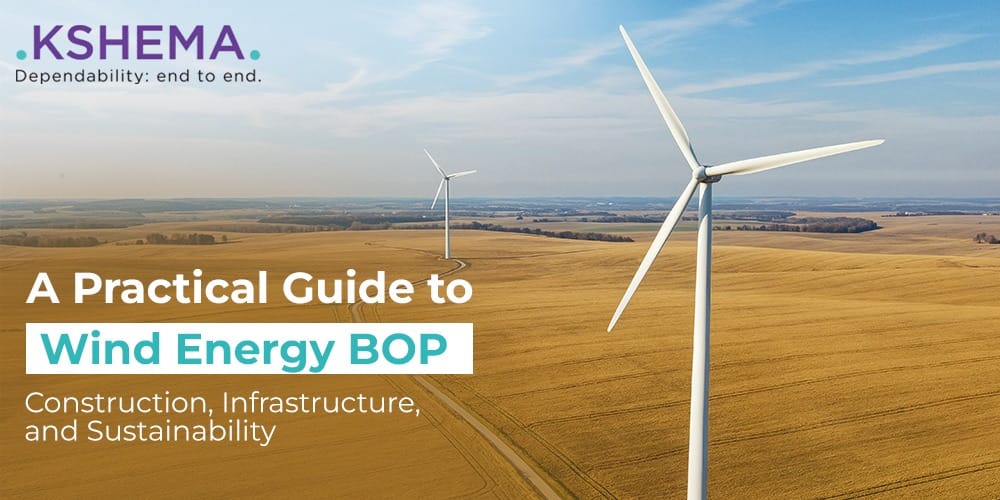
A Practical Guide to Wind Energy BOP: Construction, Infrastructure, and Sustainability

When a wind farm is being developed, the turbine is the most highlighted part. But, installing them and connecting them to the grid involves a substantial amount of work on the ground: foundations, civil works, logistics, substation construction, and electrical networks spread throughout the project site. All of these ecosystems are known as the Balance of Plant (BOP) scope.  In simpler words, the balance of plant meaning is everything a wind farm needs from the turbine itself. 

The country is working on doubling carbon-reduction mandates and net-zero commitments, BOP execution has shifted from a technical work into a strategic empowerer of renewable-energy expansion.

Wind developers are now consistently looking to partner with BOP experts for compliance, cost, discipline, land optimisation, speed, and future-ready design. That’s where Kshema Power India has built its expertise.

What Is BOP in Wind Energy?

Balance of Plant (BOP) refers to every supporting system and structure of a power project, excluding the main generating unit. In a wind farm, the main unit is the Wind Turbine Generator (WTG) and everything else, from foundations to substations, is BOP.

The term is very common in procurement. Developers use it to split a project into a turbine supply package and a BOP package, so BOP contracts have their own scope and schedule. BOP makes sure the turbines can be transported, erected, connected, and operated safely.

What is Electrical Balance of Plant?

eBOP stands for Electrical Balance of Plant. It covers every electrical system between the turbine terminals and the point where power enters the grid. Civil and mechanical work is easy to see on site. eBOP work happens underground and inside switchgear rooms, so errors surface late and cost more to fix.

Key eBOP interfaces include:

  • Turbine terminals
  • Collector network
  • Pooling substation
  • Grid connection point

Grid synchronization depends on correct protection environments and clean terminations; eBOP quality shows up directly in commissioning time.

How the Scope Changes by Technology

The BOP system in a power plant covers everything that supports the main generating equipment. What counts as main equipment changes with the technology, so the BOP scope changes with it. The table below compares the BOP system power plant scoe for wind, solar PV, and thermal projects.

Plant TypeMain UnitTypical BOP Scope
WindWind Turbine GeneratorFoundations, roads, cabling, substation
Solar PVPV modulesMounting structures, cabling, inverters, substation
ThermalBoiler, turbine & generatorFuel handling, cooling water, ash handling, switchyard

Components of Wind Energy BOP: Civil, Mechanical & Electrical

Civil BOP

Civil BOP establishes the physical backbone of the wind farm. Core activities include:

  • WTG foundations
  • Crane platforms
  • Internal & access roads
  • Cast-in-situ works
  • Substation civil works
  • Control building construction
  • Drainage & land development
  • Cable trenching

Mechanical BOP

Mechanical BOP supports the lifting, alignment & fixing of turbine components.

Key components include:

  • Tower section alignment
  • Nacelle mounting support
  • Bolt tensioning & torque tooling
  • Handling tools & fixtures
  • Yaw system integration
  • Mechanical safety components

Electrical BOP

Electrical BOP is the circulatory system of the wind farm, moving power out and data back. That is the eBOP meaning in everyday site terms.  It Includes:

  • MV & HV cabling
  • Transformer installation
  • Switchyard setup
  • Protection & metering systems
  • SCADA integration
  • Earthing systems
  • Cable routing & terminations

Civil BOP vs Mechanical BOP vs Electrical BOP

AspectCivil BOPMechanical BOPElectrical BOP
Site FootprintLargest, spread across the project areaConcentrated at each turbine locationLinear, along cable routes & substations
Typical DelayRain, soil conditions & land accessCrane availability & weather windowsMaterial delivery & grid clearances
Quality CheckConcrete cube tests, compaction resultsTorque records, alignment readingsInsulation resistance, protection tests
Handover PointFoundation & road acceptanceErection completionEnergization & grid synchronization

With civil readiness gating the cranes and the cranes gating terminations, a one-week slip in foundations rarely stays a one-week slip.

BOP Construction: From Land Clearance to Commissioning

BOP construction follows a fixed order, and each stage hands a finished input to the next.

Typical stages include:

  • Site survey & geotechnical investigation
  • Land clearing & access road formation
  • Foundation excavation & casting
  • Cable trenching & laying
  • Substation civil & electrical works
  • Turbine erection support
  • Testing & pre-commissioning
  • Grid synchronization & handover

With foundations needing time to cure before crane loads arrive, the schedule is built backward from the erection date.

Infrastructure & Logistics Realities in Wind Projects

Blades and tower sections are long and heavy, and village roads were never built for them. Planning checks include:

  • Route survey & road widening
  • Bridge & culvert load assessment
  • Overhead line & junction clearance
  • Heavy-haul transport
  • Crane mobilization
  • On-site storage & sequencing

This is where early route assessment prevents standstill costs at the turbine pad, a common cause of avoidable delay.

Sustainability: How Efficient BOP Supports Clean-Energy Goals

A wind farm starts cutting emissions only when it is running, so every month lost in BOP delays the clean power it was built to deliver.

BOP choices also decide how much land and material the project consumes.

Sustainability gains from efficient BOP include:

  • Optimized road & cable layouts
  • Lower material waste on site
  • Reuse of excavated soil
  • Reduced electrical losses
  • Fewer rework & transport trips
  • Decommissioning-ready design

A large share of a wind farm’s land and material footprint is fixed during BOP design, before the first turbine arrives.

How Kshema Power India Delivers End-to-End BOP Excellence

Kshema Power India Renewables manages complete wind farm BOP packages, keeping engineering, permits, construction, logistics, and commissioning under one plan.

The service framework includes:

  • Project Management
  • Land Permits & Approvals
  • Civil, Mechanical & Electrical BOP
  • Logistics & Supply Chain

The value proposition:

  • Quality-driven execution
  • Proven methodologies
  • Cost-controlled delivery
  • Safety & compliance leadership
  • Deep wind-sector specialization
  • Reduced project downtime

With developers asking for shorter commissioning windows, tight site control is what separates a delivered date from a promised one.

Conclusion

Balance of Plant decides whether a turbine waits idle or feeds the grid for decades.

Developers comparing BOP partners can start with four checks: how the scope splits between the WTG and BOP packages, who carries land and permit risk, who owns route clearance, and how the electrical interface is tested before energization.

Kshema Power India supports wind developers across each of these, from land permits to grid synchronization, in line with India’s carbon-reduction agenda.
Share On :
Scroll to Top

Narayan Kailas Iyer

Assistant Vice President – Quality, Health, Safety & Environment (QHSE)

With over 25 years of global experience in Quality, Health, Safety & Environment (QHSE) across energy, infrastructure, oil & gas, substations, healthcare, and high-rise developments, I lead the QHSE function at Kshema Power & Infrastructure, strengthening safety systems, quality governance, and operational discipline across projects and regions.

My professional journey includes senior leadership roles with organizations such as Algihaz Contracting Company and El-Seif Engineering Contracting Co. Ltd., where I led organization-wide QHSE strategy, ISO compliance, risk governance, audits, and safety culture transformation for large-scale, multi-billion projects.

At Kshema Power, my focus is on embedding a proactive safety culture, enhancing quality performance, and enabling sustainable project delivery aligned with global best practices and client expectations.

Mrutunjaya Sahoo

Assistant Vice President – Finance & Accounts

With over 13 years of expertise in audit and finance, I lead the Finance & Accounts division at Kshema Power with a clear mission—to build a cash-rich, resilient organization through strategic planning and smart fund optimization. A B.Com graduate from Utkal University (2007) and a Chartered Accountant since 2013, I believe every number tells a story and every decision shapes the future. My focus lies in governance, risk management, and aligning financial strategy with business vision to drive sustainable growth and strengthen Kshema’s position as a trusted leader in the renewable energy EPC sector.

Capt. John Gomez

Vice President HR

With over 25 years in HR leadership, I specialize in building people-first strategies that elevate performance and culture. I’ve led global HR operations at Constell Group and currently head HR for Doosan Bobcat India, managing diverse teams across regions.

My focus has always been on driving impact through innovative talent programs, leadership development, and retention strategies. As a certified facilitator and trainer, I’m passionate about enabling growth at both individual and organizational levels.

Rooted in a military background, I bring discipline, resilience, and a results-driven mindset to every challenge I take on.

Mohan Shanmugam

Head of Projects

With over three decades in the energy sector, I’ve led major power and transmission projects across the Middle East and India. At Al Gihaz Holding in Saudi Arabia, I managed the full delivery of EHV transmission and Smart RMU projects worth more than SAR 3.8 billion, steering every phase from bidding to execution. I’ve also guided senior teams in the wind energy space at Senvion India and Alfanar – India, deepening my experience in the renewable transition.

At Kshema Power, I am focused on steering projects at a pivotal moment in the renewable energy landscape. Leading a company committed to innovation in hybrid systems is deeply motivating. My priority is to bring global best practices into every aspect of execution—ensuring we scale with unwavering standards of safety, quality, and precision in delivery.

V. N. Kalyanasundaram

Vice President – Supply Chain Management

With over 37 years of exclusive experience in supply chain management across India and South Asia, I have led high-impact functions in one of the region’s largest multinational engineering companies as well as a leading cement manufacturer. My career has been shaped by a deep commitment to building supply chain systems defined by precision, resilience, and meaningful operational impact.

At Kshema, I lead the global supply chain function for all projects worldwide—driving efficiency, reliability, and seamless execution across every region we serve. My focus is on developing agile, future-ready supply chains that not only strengthen our operational excellence but also advance Kshema’s vision of a sustainable, next-generation energy landscape across the globe.

Srinivas Suthram

Head of Business Development

With over 27 years of experience in Sales and Business Development, I specialize in driving growth across the Power (Wind) and Capital Goods sectors. My career spans strategic roles in concept selling, market expansion, contract negotiation, and customer engagement.

At Kshema, I lead business development efforts with a focus on expanding our footprint in the renewable energy EPC space.

My goal is to strengthen market presence, explore new geographies, and ensure consistent topline and bottom-line performance. I believe in strategic execution, teamwork, and long-term planning that continue to guide my approach to building sustainable business growth.

Rajagopal Venkatesan

Head of Engineering & Design

As an electrical engineer with 30 years of experience in designing and delivering renewable power infrastructure, I’ve had the opportunity to work across diverse environments—including leading Gas Insulated Substation projects in Malaysia. Every role has strengthened my belief in building energy systems that are reliable, future-ready, and engineered with precision.

At Kshema, I oversee bidding, execution, transmission & distribution, and our design–engineering function. My focus is on creating solutions that not only meet today’s energy demands but shape the next chapter of sustainable power infrastructure.

Narayan Kumar

Chief Executive Officer (CEO)

With over 30 years of experience in renewable energy and telecom, I lead Kshema Power’s India operations, overseeing strategy, growth, and profitability. My journey spans leadership roles at global firms like Vestas and Acciona, where I gained deep insights into energy business dynamics and people management.

I hold an MBA and have completed executive programs from MIT Sloan, with a focus on innovation and entrepreneurship. At Kshema, my priority is building a performance-driven culture and delivering long-term value through sustainable energy solutions.

Ranjith Nair

Director – Global Expansion & Strategy

Over the past 35 years, my journey as a mechanical engineer has taken me across the global energy landscape — from Siemens , Doosan Skoda Power , SABIC to ENGIE and Sterlite Power. Each chapter has shaped how I understand energy sector, people, and the future we are collectively responsible for building. I’ve led projects across thermal and renewable sectors, managed EPC operations end-to-end, and driven P&L and BOOM-based renewable development. But what has stayed constant is my belief that energy is more than infrastructure — it is impact.

Today, I bring this experience to Kshema, where I focus on expanding our global footprint and strengthening our strategic direction. My mission is to help shape a future where sustainable energy is not just an industry goal but a living reality for communities around the world for the future

Amritha Basanth

Director

As a Director of the Kshema Group, I lead our global expansion and Middle East operations, driven by a commitment to sustainable growth and meaningful impact. I also head the UKF College of Engineering & Technology, where I work to inspire future engineers through innovative, purposeful education.

Recognized through honors such as the Women in Wind Leadership Program 2022 and the Exceptional Women of Excellence Award 2019, I continue to champion women’s leadership and push boundaries in the renewable energy sector—proving that women can shape the future of energy with vision and courage.

Abhinand Basant

Deputy Managing Director

Committed to transforming lives and communities through sustainable energy, I lead Kshema Power’s global vision to build a cleaner, fairer future. In 2020, I led India’s largest single wind turbine project (326.7 MW) — a milestone that reinforced my dedication to renewable transformation.

With a Master’s in Innovation Management & Entrepreneurship from the UK, I focus on advancing green hydrogen, energy storage, and EV infrastructure, turning innovation into measurable impact. As Kshema expands across India, the Middle East, and the UK, my mission is to empower people and businesses to see that progress and purpose can thrive together.

Dr. Basant

Chairman and Managing Director

With over two decades of entrepreneurial experience, I have dedicated my journey to transforming India’s renewable energy landscape. I recognized the potential of this sector back in 1998, when clean energy was still an emerging idea — and that vision became the foundation of Kshema Power.

In 2015–16, I had the privilege of leading the development of 350 MW of wind projects in a single year, one of our proudest milestones. Alongside my passion for renewable energy, I serve as the Chairman of UKF College of Engineering & Technology, where we nurture over 1,000 students to become innovators and problem-solvers of tomorrow.

Over the years, I’ve been honoured with recognitions such as the Best Renewable Energy Developer Award (MNRE, 2016) and The Times of India’s Brand Icon Award (2016). But beyond awards, what drives me is the belief that true progress comes from empowering people and creating a sustainable future for all.